Anorexia nervosa, often referred to simply as anorexia,[11] is an eating disorder, characterized by low weight, food restriction, fear of gaining weight and a strong desire to be thin.[1] Many people with anorexia see themselves as overweight even though they are, in fact, underweight.[1][2] They often deny that they have a problem with low weight.[3] They weigh themselves frequently, eat small amounts and only eat certain foods.[1] Some exercise excessively, force themselves to vomit, or use laxatives to lose weight.[1] Complications may include osteoporosis, infertility and heart damage, among others.[1] Women will often stop having menstrual periods.[3] In extreme cases, people with anorexia who continually refuse significant dietary intake and weight restoration interventions, and are declared incompetent to make decisions by a psychiatrist, may be fed by force under restraint via nasogastric tube[12] after asking their parents or proxies[13] to make the decision for them.[14]

The cause is currently unknown.[2] There appear to be some genetic components with identical twins more often affected than fraternal twins.[2] Cultural factors also appear to play a role, with societies that value thinness having higher rates of disease.[3] Additionally, it occurs more commonly among those involved in activities that value thinness, such as high-level athletics, modeling and dancing.[3][4] Anorexia often begins following a major life-change or stress-inducing event.[3] The diagnosis requires a significantly low weight.[3] The severity of disease is based on body mass index (BMI) in adults with mild disease having a BMI of greater than 17, moderate a BMI of 16 to 17, severe a BMI of 15 to 16, and extreme a BMI less than 15.[3] In children a BMI for age percentile of less than the 5th percentile is often used.[3]
Treatment of anorexia involves restoring a healthy weight, treating the underlying psychological problems and addressing behaviors that promote the problem.[1] While medications do not help with weight gain, they may be used to help with associated anxiety or depression.[1] Different therapy methods may be useful, such as cognitive behavioral therapy or an approach where parents assume responsibility for feeding their child known as Maudsley family therapy.[1][15] Sometimes people require admission to a hospital to restore weight.[7] Evidence for benefit from nasogastric tube feeding, however is unclear;[16] such an intervention may be highly distressing for both anorexia patients and healthcare staff when administered against the patient's will under restraint.[12] Some people with anorexia will just have a single episode and recover while others may have recurring episodes over years.[7] Many complications improve or resolve with regaining of weight.[7]
Globally, anorexia is estimated to affect 2.9 million people as of 2015.[9] It is estimated to occur in 0.9% to 4.3% of women and 0.2% to 0.3% of men in Western countries at some point in their life.[17] About 0.4% of young women are affected in a given year and it is estimated to occur ten times more commonly among women than men.[3][17] Rates in most of the developing world are unclear.[3] Often it begins during the teen years or young adulthood.[1] While anorexia became more commonly diagnosed during the 20th century it is unclear if this was due to an increase in its frequency or simply better diagnosis.[2] In 2013 it directly resulted in about 600 deaths globally, up from 400 deaths in 1990.[18] Eating disorders also increase a person's risk of death from a wide range of other causes, including suicide.[1][17] About 5% of people with anorexia die from complications over a ten-year period, a nearly six times increased risk.[3][8] The term "anorexia nervosa" was first used in 1873 by William Gull to describe this condition.[19]
Signs and symptoms
Causes
Mechanisms
Diagnosis
Treatment
Prognosis
Epidemiology
Anorexia is estimated to occur in 0.9% to 4.3% of women and 0.2% to 0.3% of men in Western countries at some point in their life.[17] About 0.4% of young females are affected in a given year and it is estimated to occur three to ten times less commonly in males.[3][17][149] Rates in most of the developing world are unclear.[3] Often it begins during the teen years or young adulthood.[1]
The lifetime rate of atypical anorexia nervosa, a form of ED-NOS in which the person loses a significant amount of weight and is at risk for serious medical complications despite having a higher body-mass index, is much higher, at 5–12%.[150]
While anorexia became more commonly diagnosed during the 20th century it is unclear if this was due to an increase in its frequency or simply better diagnosis.[2] Most studies show that since at least 1970 the incidence of AN in adult women is fairly constant, while there is some indication that the incidence may have been increasing for girls aged between 14 and 20.[17] According to researcher Ben Radford who wrote in Skeptical Inquirer "I found many examples of flawed, misleading, and sometimes completely wrong information and data being copied and widely disseminated among eating disorder organizations and educators without anyone bothering to consult the original research to verify its accuracy". Radford states that misleading statistics and data have been ignored by organizations like the National Eating Disorder Association who has not released data for "incidence of anorexia from 1984–2017" he states that each agency continues to report incorrect numbers assuming that someone else has checked the accuracy.[151]
Underrepresentation
Eating disorders are less reported in preindustrial, non-westernized countries than in Western countries. In Africa, not including South Africa, the only data presenting information about eating disorders occurs in case reports and isolated studies, not studies investigating prevalence. Data shows in research that in westernized civilizations, ethnic minorities have very similar rates of eating disorders, contrary to the belief that eating disorders predominantly occur in white people.[medical citation needed]
Men (and women) who might otherwise be diagnosed with anorexia may not meet the DSM IV criteria for BMI since they have muscle weight, but have very little fat.[152] Male and female athletes are often overlooked as anorexic.[152] Research emphasizes the importance to take athletes' diet, weight and symptoms into account when diagnosing anorexia, instead of just looking at weight and BMI. For athletes, ritualized activities such as weigh-ins place emphasis on weight, which may promote the development of eating disorders among them.[citation needed] While women use diet pills, which is an indicator of unhealthy behavior and an eating disorder, men use steroids, which contextualizes the beauty ideals for genders.[50] In a Canadian study, 4% of boys in grade nine used anabolic steroids.[50] Anorexic men are sometimes referred to as manorexic.[153]
History
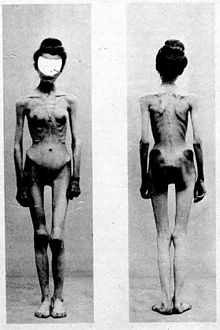
The term "anorexia nervosa" was coined in 1873 by Sir William Gull, one of Queen Victoria's personal physicians.[19] The history of anorexia nervosa begins with descriptions of religious fasting dating from the Hellenistic era[154] and continuing into the medieval period. The medieval practice of self-starvation by women, including some young women, in the name of religious piety and purity also concerns anorexia nervosa; it is sometimes referred to as anorexia mirabilis.[155][156]
The earliest medical descriptions of anorexic illnesses are generally credited to English physician Richard Morton in 1689.[154] Case descriptions fitting anorexic illnesses continued throughout the 17th, 18th and 19th centuries.[157]
In the late 19th century anorexia nervosa became widely accepted by the medical profession as a recognized condition. In 1873, Sir William Gull, one of Queen Victoria's personal physicians, published a seminal paper which coined the term "anorexia nervosa" and provided a number of detailed case descriptions and treatments.[157] In the same year, French physician Ernest-Charles Lasègue similarly published details of a number of cases in a paper entitled De l'Anorexie hystérique.[158]
Awareness of the condition was largely limited to the medical profession until the latter part of the 20th century, when German-American psychoanalyst Hilde Bruch published The Golden Cage: the Enigma of Anorexia Nervosa in 1978. Despite major advances in neuroscience,[159] Bruch's theories tend to dominate popular thinking. A further important event was the death of the popular singer and drummer Karen Carpenter in 1983, which prompted widespread ongoing media coverage of eating disorders.[160]
Etymology
The term is of Greek origin: an- (ἀν-, prefix denoting negation) and orexis (ὄρεξις, "appetite"), translating literally to a nervous loss of appetite.
| This article uses material from the Wikipedia article Metasyntactic variable, which is released under the Creative Commons Attribution-ShareAlike 3.0 Unported License. |